

The main risks of outsourcing your marketing are poor quality work, lack of strategic alignment with your business, slow communication, over-reliance on a single contact who might leave or be working in a different timezone, and paying for activity without seeing results. All of these are real risks and are avoidable with the right partner and the right setup.
Outsourcing marketing is one of the smartest moves a small business can make. But like any business decision, doing it well requires knowing what can go wrong.
The Most Common Risks of Outsourcing Marketing - and How to Avoid Them
Risk 1: You get junior execution, not senior experience
This is the most common complaint from businesses who've had a bad agency experience. They hired what looked like a capable team, and quickly discovered the senior people who pitched the business handed it straight to a junior account coordinator.
How to avoid it: Ask explicitly who will be doing the day-to-day work before you sign anything. Request to meet the people who'll be on your account - not just the directors. A good agency won't have any problem with this.
Risk 2: The agency doesn't understand your business
Generic marketing rarely works. If your agency treats you like every other client, produces templated social content, and never asks about your customers or your goals, you'll get mediocre results.
How to avoid it: In your first meeting, pay attention to how many questions they ask vs. how much they pitch. A curious agency that genuinely wants to understand your business before proposing a solution is a far safer bet than one that arrives with a pre-built deck.
Risk 3: Poor communication and slow response times
Virtual working is the norm for many agencies and it works well when done properly. But some agencies are hard to reach, slow to respond, and leave clients feeling like an afterthought.
How to avoid it: Ask upfront about communication methods. How often do they check in? What's their typical response time? Do you have a single point of contact or are emails going to a shared inbox?
Risk 4: You lose visibility of what's happening
Some agencies keep clients in the dark by producing activity reports full of impressions and reach, but never connecting the work to business outcomes.
How to avoid it: Ask what reporting looks like before you start. You want reports that cover what was done, what it cost, and what it achieved in terms that matter to your business (leads, revenue, website traffic, conversions).
Risk 5: Over-dependence on a freelancer
If your entire marketing relationship sits with one freelancer, you're exposed if that person is unavailable. This is a particular risk with individual freelancers and smaller agencies.
How to avoid it: Choose a partner with a proper team structure and documented processes. At a well-run agency, your account should be able to continue without interruption if your main contact is away.
Risk 6: Lock-in before trust is established
Long contracts protect the agency, not the client. Look for monthly terms with one month's notice. Any agency confident in its own work should be happy with this.
Risk 7: Activity without results
Before you start, agree on what success looks like in measurable terms. Set goals that connect to business outcomes - leads, enquiries, conversions, revenue - rather than vanity metrics. Review these quarterly, not annually.
What Good Outsourcing Looks Like
The risks above are real, but they're the exception rather than the rule when you choose carefully. The best outsourced marketing relationships feel like having a senior marketing team embedded in your business.
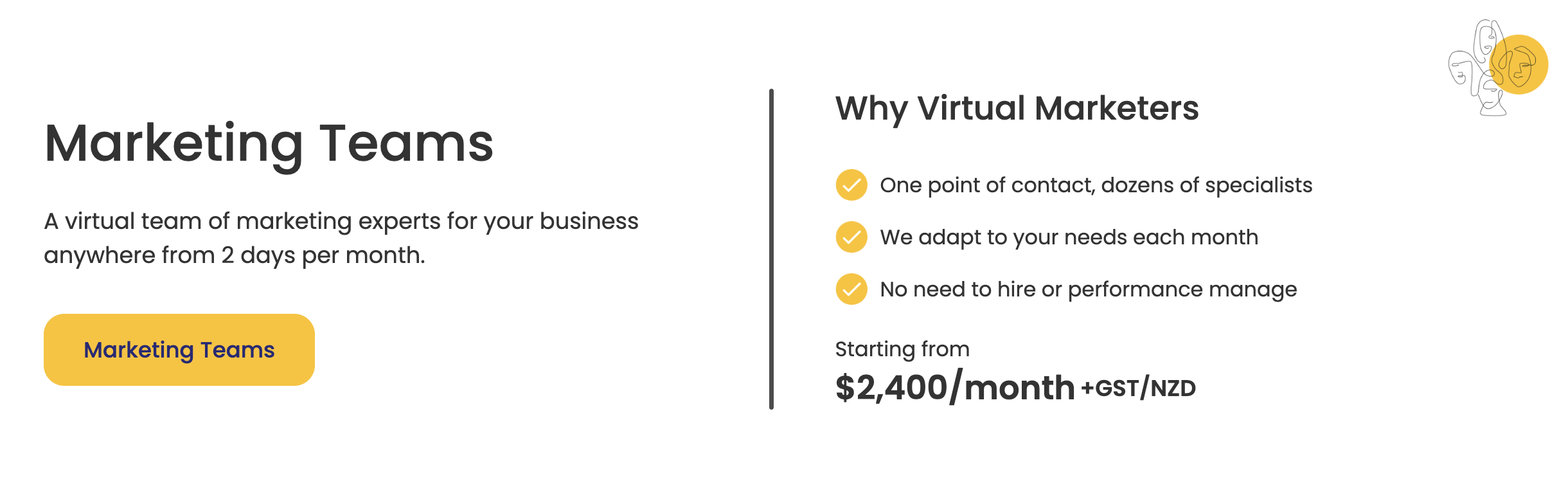
At Virtual Marketers, clients have a dedicated Marketing Manager as their single point of contact, with a full team of specialists behind them. Reporting connects activity to outcomes. And contracts run monthly with one month's notice. Retainers start from $2,400/month + GST.
Frequently Asked Questions
How do I know if my outsourced marketing is working?
Set clear goals before you start - ideally with your agency - and review them monthly. Good initial indicators include website traffic, enquiry volume, and lead quality. Revenue impact takes longer to show but should be trackable over a 3-6 month window.
What happens if I'm unhappy with my marketing agency?
Raise it directly and early. Most agencies want to fix problems if given the chance. If things don't improve, the right contract structure (monthly terms, short notice) means you can move on without a costly exit.
Is outsourcing marketing riskier than hiring in-house?
Not necessarily. In-house hires carry their own risks as a bad hire is expensive, takes months to replace, and often takes time away from the rest of the business. With outsourcing, the risk is more visible and easier to address quickly.
How can I protect myself when starting with a new agency?
Start with a defined project or short initial engagement rather than jumping straight to a long retainer. This lets both parties test the relationship before committing to ongoing work.
Should I get references before hiring a marketing agency?
Yes. Ask for two or three client references you can speak to directly - not just written testimonials on their website. Ask about communication, results, and whether they'd hire the agency again.
Work with a Partner You Can Trust
The risks of outsourcing marketing are manageable. The key is choosing a partner with the right model, the right people, and the right approach to accountability.



.png)



.png)


