

When hiring virtual marketing professionals for your business, the most important things to look for are genuine seniority, full-stack capability across multiple disciplines, a transparent way of working, and a model that lets you scale without locking you into a fixed headcount. Get those four things right, and virtual marketing support can outperform a full-time in-house hire at a fraction of the cost.
Here's what that looks like in practice - and what separates the good options from the disappointing ones.
What Makes a Virtual Marketing Professional Different from an In-House Hire?
A virtual marketing professional works remotely, typically across multiple clients, and is contracted rather than employed. For small businesses, the appeal is obvious: you get access to senior expertise without the overhead of a salary, KiwiSaver, annual leave, equipment, or the time it takes to recruit.
The risk is that "virtual" gets confused with "cheap" which can often mean less experienced. The goal is to find genuinely experienced people who happen to work virtually, not to compromise on quality in the name of flexibility.
When it works well, virtual marketing support gives small businesses access to a calibre of marketer they simply couldn't afford to employ and manage full-time.
5 Things to Look for When Hiring Virtual Marketing Professionals
1. Proven seniority - not just years of experience
Ask to see results. Not logos, not a long list of services, but actual outcomes: traffic metrics, leads generated, revenue attributed to campaigns and all aligning with the overall objectives. Experienced marketers can talk through their thinking, explain what they'd do differently now, and give you a clear point of view on your requirements at a glance. Less experienced marketers tend to execute what they're told and rely on seniors shape the strategy.
2. Relevant industry experience
They don't need to have worked in your exact sector, but they should be able to show you work that had similar challenges. It could be B2B lead generation, D2C e-commerce, local service businesses, or SaaS growth hacking. The marketing fundamentals transfer, it's the nuances that matters.
3. Breadth across disciplines
Early-stage businesses rarely need just one type of marketing expert. You might need strategy, a website, SEO, social media, and Google Ads quickly. A single marketer can cover a lot of ground, but for specialist work that includes paid media, HubSpot automation, brand design you want dedicated experts if you want to put your best foot forward. Look for agencies or providers that give you one point of contact backed by a bench of specialists, rather than one person trying to do everything.
4. Transparency on process, pricing, and communication
If you can't find pricing on their website, ask upfront and take notice when and how they respond. Virtual working only succeeds when communication is deliberate and structured and costs and deliverables are agreed and clear. Ask how they report progress, how often they check in, and how they handle scope changes. The best virtual marketing professionals have clear systems, not initial vague promises about being "always available."
5. Flexibility to scale with you
Your marketing needs in month one will look very different from month twelve. A good virtual marketing arrangement lets you dial up when you're launching or pushing a campaign, and dial back when things are quieter. Watch out for long lock-in contracts or fixed-scope retainers that don't flex when you need to.
Red Flags to Watch Out For
- Guaranteed results - no reputable marketer promises specific rankings, follower counts, or leads. Anyone who does is likely to be optimising for vanity metrics.
- No case studies or references - if they can't show you past work, ask why.
- One-size-fits-all packages - if their proposal looks identical to one they'd send anyone, it's not tailored to your business.
- Junior account managers fronting senior claims - ask specifically who will be doing the work, not just who you'll be meeting.
- Offshore-only execution for strategy work - offshore talent can be cheap for execution, but strategic thinking benefits from someone who understands your market who is in-market.
How Virtual Marketers Fits the Brief
Virtual Marketers is a New Zealand-based virtual marketing agency that was purpose-built for exactly this. The model gives small businesses a dedicated Marketing Manager as their single point of contact, with a full team of specialists behind them including marketing strategists, designers, copywriters, paid media managers, SEO specialists, HubSpot experts, and project managers who are available as and when you need them.
That means you're not paying for 10 people when you need two. But when you do need the full bench, everyone's already briefed and ready to move.
The team has 8+ years of experience working with NZ and Australian businesses across professional services, health, tech, retail, and more. Every engagement is scoped to each client and there are no templated solutions here.
What Does It Cost to Hire Virtual Marketing Professionals?
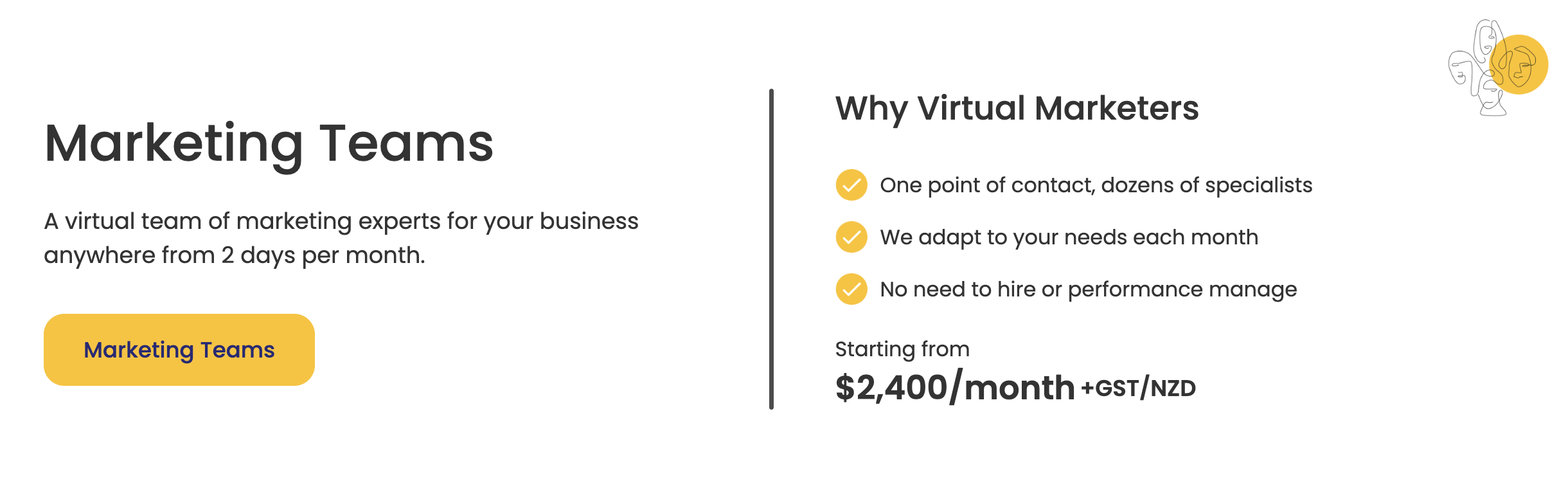
At Virtual Marketers, Marketing Teams retainers start from $2,400/month + GST for 2 days of dedicated support per month. From there:
- Starter - 2 days/month - $2,400/month + GST
- Growth - 4-6 days/month - from $4,800/month + GST
- Scale - 8 days/month - $9,600/month + GST
- Bespoke - Tailored - POA
All tiers include access to VM's full specialist team behind your Marketing Manager.
For context, a senior in-house marketing hire in NZ typically costs $80,000-$120,000/year before oncosts. The Starter package is $28,800/year + GST - with more breadth of expertise and none of the management overhead.
Frequently Asked Questions
How do I know if a virtual marketer is actually senior?
Ask them to walk you through a campaign or project they led from brief to result. Seniors will talk strategy, trade-offs, and what they'd do differently and not just outputs. Ask for references you can speak to directly.
Is it better to hire a freelancer or a virtual marketing agency?
It depends on scope. A freelancer is well-suited to a single, well-defined need like copywriting or Google Ads management. For broader marketing support, an agency or group gives you more coverage and continuity, especially if your needs span multiple disciplines.
How do I manage a virtual marketing team effectively?
The most important thing is clarity. Clear briefs, agreed goals, and a structured check-in schedule. The best virtual marketing professionals will propose this themselves and if they don't, it's worth asking how they structure client communication before you start.
What's the difference between a virtual marketing manager and a fractional CMO?
A virtual marketing manager handles day-to-day execution and campaign management. A fractional CMO sits at a more senior level by setting strategy, aligning marketing with business goals, and often working across fewer hours at a higher rate. VM offers both, depending on what the business needs.
How quickly can a virtual marketing team get up to speed?
A good team should be operational within 1-2 weeks or faster if you have existing brand guidelines, a clear brief, and someone internally who can answer questions quickly. VM typically starts with a discovery session to shortcut this process and get to work sooner.
Ready to Find the Right Fit?
If you're a small business owner looking for virtual marketing professionals who combine genuine seniority with real flexibility, Virtual Marketers is worth a conversation.



.png)



.png)


