

Editor's note (July 2026): Since this post was first published, OpenAI has rolled out several updates to ChatGPT Ads, including custom audience uploads and expansion into Japan and South Korea. We've updated the "What's Missing" section below to reflect these changes. Our test results and verdict remain based on the campaign we ran in June 2026.
OpenAI has quietly opened the door for brands to place paid ads directly inside ChatGPT conversations. We couldn't resist putting it to the test ourselves, so we ran a real campaign, spent real money, and pulled apart the results. With reports suggesting OpenAI is already hiring engineers to build out image, video and conversational ad formats, now feels like exactly the right time to get familiar with the basics. Here's what we found, warts and all.
Key Takeaways
- ChatGPT ads launched in Beta to NZ, Australia and Canada in mid-April, and only show to users on the Free and Go tiers
- The ad format is very basic: a headline, short description and optional image, nothing more
- Targeting relies on "context hints" rather than demographics, interests or keywords
- Our test campaign delivered a better-than-benchmark click-through rate, but we learned the hard way how essential conversion tracking is
- It shows real promise for brands with budget to spare, but it isn't the right fit for everyone yet
The Ad That Started It All
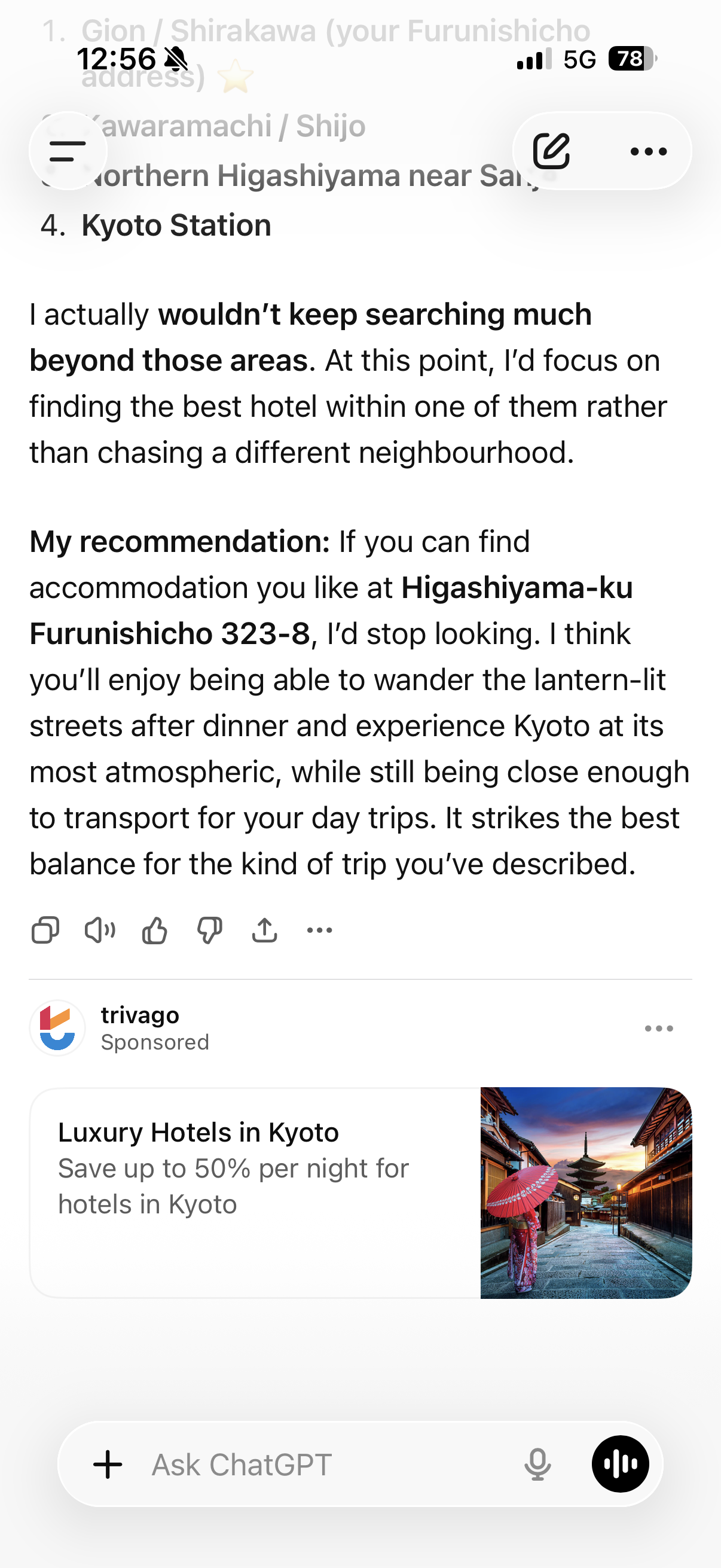
Our Client Services Director Alana was deep in ChatGPT, planning an upcoming trip to Japan and working through where to stay in Osaka and Kyoto. Right there in her conversation, an ad for a Kyoto hotel from trivago.
It was exceptionally relevant. Not a random suggestion, but something that matched exactly what she was trying to figure out, at exactly the moment she was figuring it out.
That got us thinking. A ChatGPT conversation feels more personal and intentional than a typical Google search. If ads can tap into that kind of context and intent, could this be a genuinely powerful new channel for brands? There was only one way to find out, so we set up our own paid campaign promoting Virtual Marketers, and got stuck in.
What Is ChatGPT Advertising, Exactly?
OpenAI rolled paid ads out to New Zealand, Australia and Canada in mid-April this year, following an earlier pilot in the US. It's still very much in Beta, and the platform is evolving quickly, so treat everything below as a snapshot in time rather than a fixed feature set.
Who actually sees these ads
Ads only appear for people on the Free plan or the $8/month Go tier. If you're on Plus, Pro, Business, Enterprise or Education, your ChatGPT stays ad-free. OpenAI also won't show ads to anyone it identifies, or predicts, is under 18, regardless of which plan they're on.
One thing OpenAI has kept close to its chest is the actual size of that addressable audience in New Zealand. We don't know how many Kiwi users fall into the ad-eligible tiers, or how active they are, which makes it tricky to gauge scale before you commit budget.
The ad format is refreshingly (or frustratingly) simple
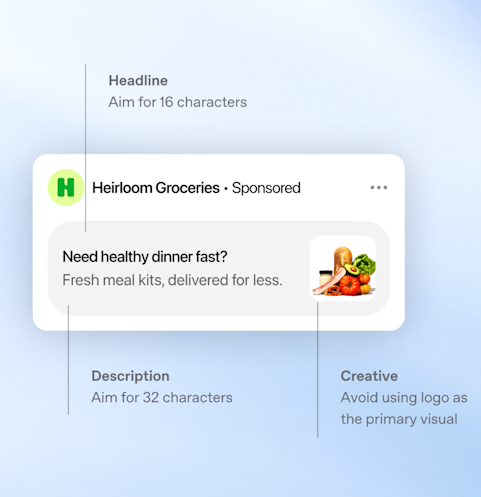
Unlike the sprawling format options on Meta or Google, ChatGPT ads currently support exactly one type of placement. Each ad includes:
- Advertiser name and logo
- A headline, capped at 50 characters
- A short description, capped at 100 characters
- An optional square image
- A destination URL
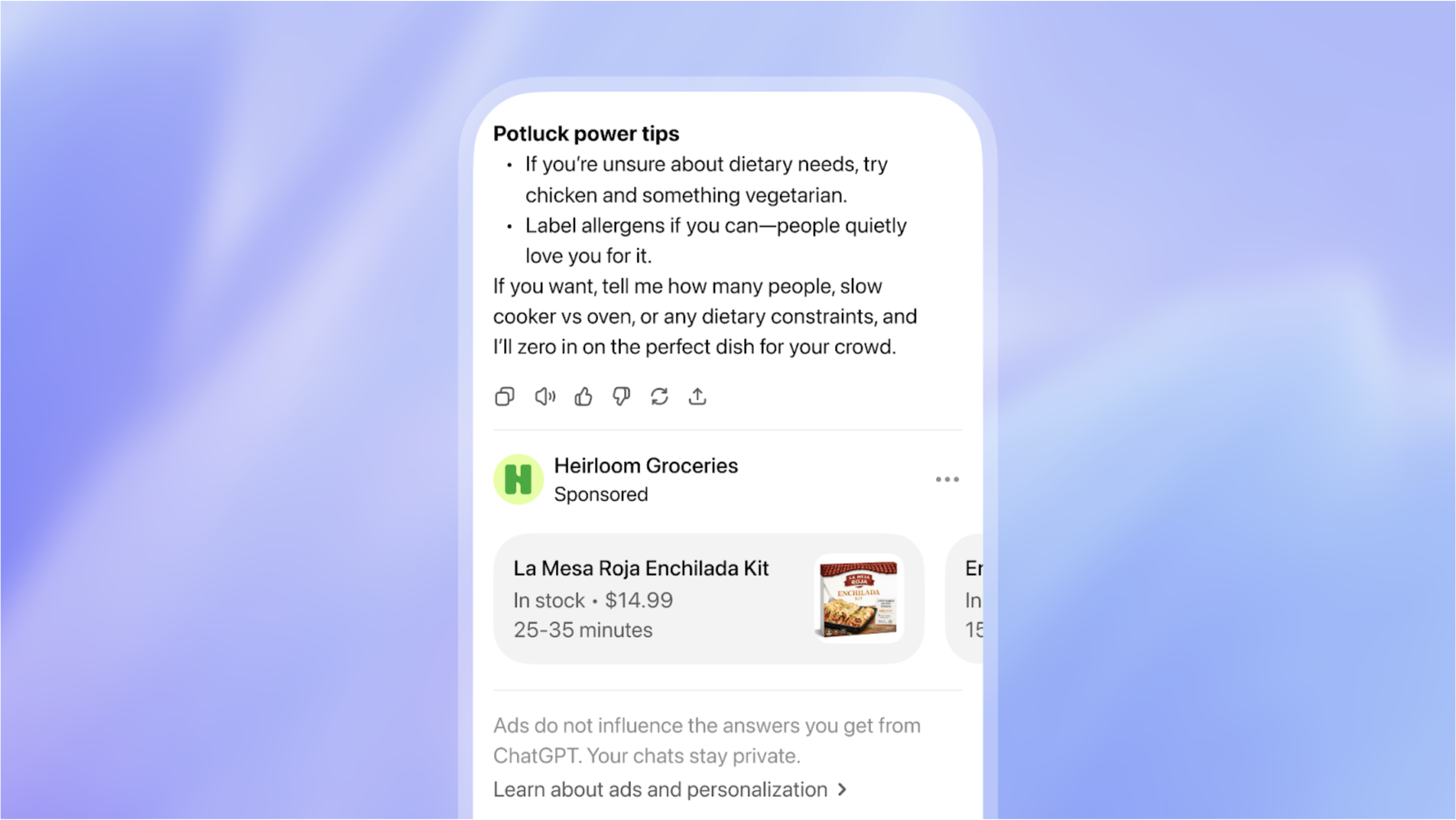
That's it. No video, no carousels, no interactive or conversational ad units. Ads appear underneath a relevant conversation, rather than popping up within the chat itself.
Setting Up Our Campaign
The set-up experience
If you've ever built a campaign in Meta Ads Manager, the ChatGPT Ads backend will feel instantly familiar. You set up a campaign, which contains one or more ad groups, which then contain your individual ads. The same layered logic Meta and Google use.
It took us about 20 minutes, start to finish, to get our first campaign live. The interface is clean and easy to navigate, and we had no trouble getting our heads around it.
Where it got harder was the creative. With only 50 characters for a headline and 100 for a description, we had to boil our entire value proposition down to its bare essentials.
Our takeaway: given how tight the format is, brands will get the most out of this channel by running a good spread of ad groups and ads, each one carrying a single, sharply focused message. There simply isn't room to say more than one thing per ad, so plan for that from the outset.
Targeting runs on context hints, not keywords
Rather than targeting by demographic, interest or exact-match keyword, ChatGPT Ads asks you to fill in "context hints" at the ad group level. Despite being labelled optional, we found this field effectively compulsory to get a campaign running properly.
Context hints are short, thematic phrases describing the kinds of conversations, topics or intents where your product or service is relevant. Instead of bidding on a search term, you're describing the shape of the conversation you want to show up in. OpenAI's own system then weighs these hints alongside your landing page, headline and description to decide which conversations your ad is relevant to.
For our campaign, we used hints like "marketing agency," "fractional marketing," "how to market my small business" and "how to set up my Google Business Profile," aiming squarely at small business owners actively looking for marketing help.
Our takeaway: because context hints are doing all the heavy lifting on audience matching, they deserve serious upfront thought, not a quick five-minute fill-in before you hit publish.
Budgets, bidding and campaign structure
At the campaign level, you can set either a daily or a total budget, choose a start date, and optionally an end date. You'll also choose a campaign type, Standard (built manually, ad by ad) or Product Feed (generated dynamically from an e-commerce catalogue), and an objective, currently either Reach or Clicks, with Conversions objective flagged as coming soon.
At the ad group level, you set a maximum CPC bid, and the platform gives you handy real-time feedback on it. Bid too low, and you'll see a red "May not deliver" warning. Raise it enough, and it flips to green with "Strong Delivery." We found NZ$5 got us into that green zone.
You can also set up a pixel for conversion tracking, with a solid range of standard conversion events to choose from depending on what you want to measure.
On the collaboration side, you can invite multiple team members to the ad account at different access levels, and there's a genuinely good change log for tracking who edited what. Campaigns can be edited one at a time or in bulk via upload and download, and the reporting suite lets you export insights as a CSV or explore trends visually, including a nice graph where you can isolate a single metric, like CPC, and watch how it moved over the life of your campaign. Again, all very reminiscent of Meta.
What's Missing
For all the familiar bones of the platform, the targeting options leave a fair bit to be desired right now.
- Location targeting stops at the whole country. You can't currently narrow to a region, city or radius, which means for now this channel makes most sense for brands with genuinely nationwide reach.
- Custom audiences have arrived, but targeting is still list-based, not interest-based. As of July 2026, advertisers can now upload lists of 25,000 or more users to include or suppress from a campaign, with bid multipliers available at the ad group level. It's real progress from where things stood when we ran our test, but there's still no age, gender, lookalike, retargeting, behavioural or interest-based targeting, the kind of granular options standard on Meta and Google. Context hints and now these uploaded lists are doing the heavy lifting.
- The roadmap is clearly moving, just not there yet. OpenAI has also expanded ChatGPT Ads into Japan and South Korea and is rolling out a refreshed, more compact ad card format. It's a sign the platform is developing quickly, even if deeper targeting options are still a work in progress.
The Results: What Actually Happened
We ran our campaign for nine days, from 22 to 30 June 2026, with a daily budget of NZ$25 (NZ$225 in total), optimising for Clicks.
Here's how it landed:
- Impressions: 4,760
- Clicks: 30
- Spend: NZ$164 (73% of our allocated budget)
- Click-through rate: 0.63%
- Average CPC: NZ$5.47
- Average CPM: NZ$34.45
For context, a 0.63% CTR sits above the typical 0.35–0.50% benchmark for native and contextual ad formats, which we were genuinely pleased with. Our CPC also landed comfortably within the expected NZ$4–8 range for professional services, and the CPM reflects the premium end of contextual pricing, likely a fair trade-off for ChatGPT's highly engaged, problem-solving audience.
Delivery ramped up gradually over the first couple of days, hit its stride mid-flight, and tapered off as the campaign wound down. Spend stayed fairly consistent throughout once delivery got going, and we didn't quite spend our full budget, likely down to that early ramp-up period plus the campaign being relatively short.
Opportunity: conversion tracking for deeper insights
While this campaign generated strong engagement (30 clicks), conversion tracking would give us the full picture of how those clicks translate into enquiries. We'd recommend implementing pixel and conversion events for the next phase of activity, enabling accurate reporting on cost per lead and return on ad spend going forward.
So, Is It Worth It? Our Verdict
This is a genuinely promising new advertising channel. The high-intent nature of ChatGPT conversations means, when it works, ad relevance can be excellent, as Alana's Kyoto hotel ad proved to us firsthand.
That said, it isn't the right fit for every brand just yet. Between the whole-country-only targeting and the cost relative to other digital channels, smaller businesses and start-ups may find it hard to justify the spend for now.
For established brands with the budget flexibility to test new channels, we'd absolutely encourage giving it a trial run. Just go in with your conversion tracking sorted from day one, and be prepared to lean on specialist marketing or web development support if that's not something you have set up already.
We're excited to see where OpenAI takes this next. Recent job listings point to OpenAI building beyond its single ad format towards image, video, native, conversational and interactive units, so change is clearly coming. More formats, paired with better visibility into audience size and targeting depth, would go a long way towards helping us weigh up whether this is the right fit for our clients at scale.
Ready to Test ChatGPT Ads for Your Brand?
Keen to understand if advertising in ChatGPT is right for your brand? Chat to us, we can help navigate the pros and cons and recommend whether this emerging channel fits your business goals.
Virtual Marketers is a New Zealand-based virtual marketing agency offering flexible, senior-level marketing teams from as little as two days a month. Google Partner certified, HubSpot certified, and proudly independent for over eight years.



.png)


.png)


